
Day trip
A day at Ise Grand Shrine, by car
Japan's most sacred shrine sits in a forest of giant cedars, about 1 hour 50 minutes from Hanaike. Visit in the traditional order, learn the few gestures that matter, park in the right place, then wander the old pilgrim street for lunch before driving home.
Check dates on Airbnb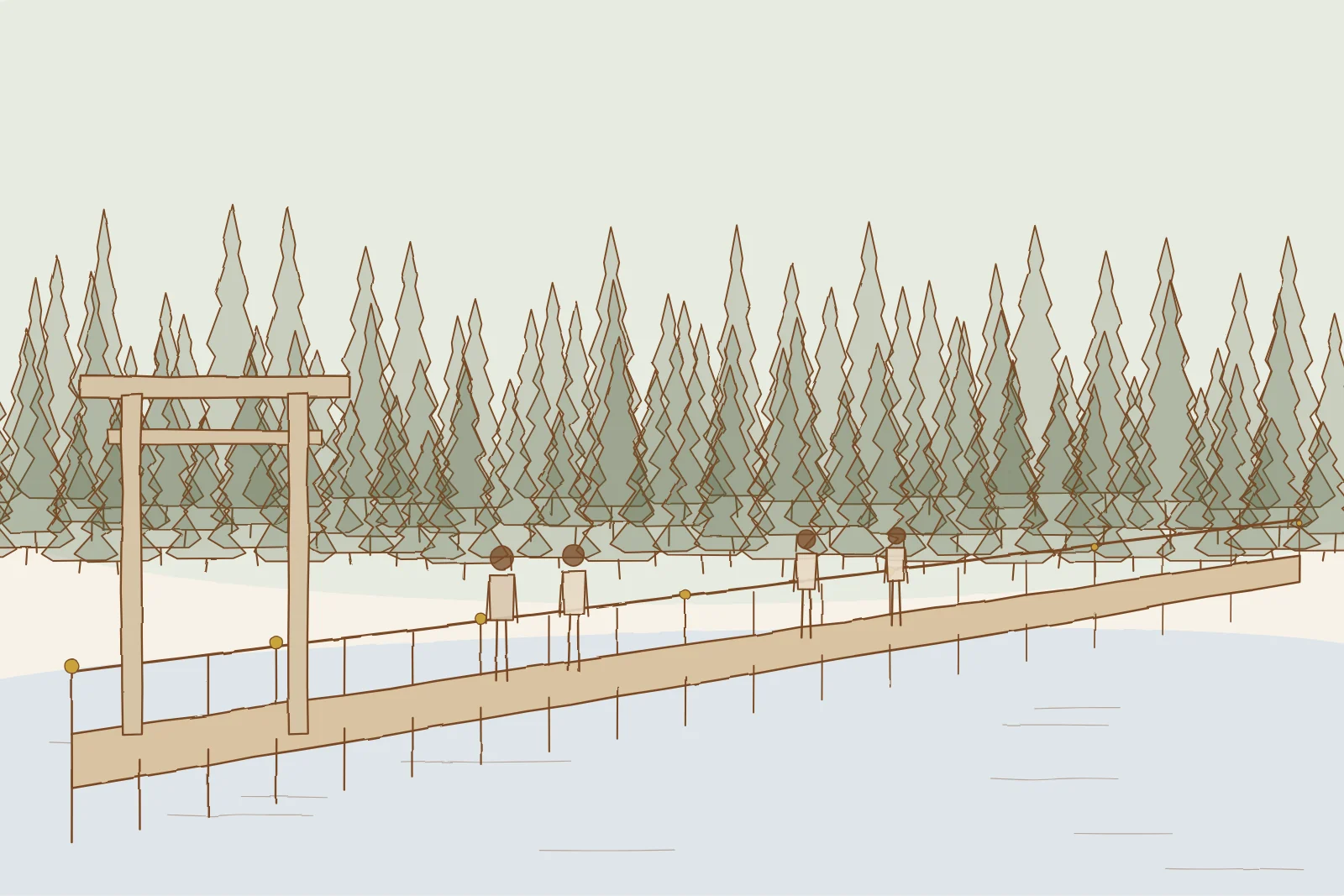
Why Ise is different from other shrines
There are tens of thousands of Shinto shrines in Japan. Ise Jingu is the one people simply call "Jingu" — the Shrine. It is not one building but 125 shrines, centred on two: the Inner Shrine (Naiku), dedicated to Amaterasu, the sun goddess and ancestral deity of the imperial family, and the Outer Shrine (Geku), dedicated to Toyouke, the deity who provides food, clothing and shelter.
What surprises most first-time visitors is how plain it is. Unpainted cypress, thatched roofs, white gravel, and cedars so tall you hear the wind before you feel it. The main sanctuaries are rebuilt from new timber every 20 years in a ceremony called Shikinen Sengu; the next one is planned for autumn 2033, and the preparations are already under way.
Getting there from Hanaike
Ise is about 1 hour 50 minutes from Hanaike Retreat by expressway. You join the Isewangan Expressway at Kariya Smart IC, about 7 minutes from the house, head west into Mie, and continue on the expressways towards Ise. Geku's car parks are about 6 minutes from Ise IC; Naiku is about 5 minutes from Ise-nishi IC or Ise IC.
Kariya Smart IC is ETC-only, so make sure your rental car has an ETC card. It is a straightforward drive — mostly expressway, with very little city driving at either end.
Geku first, then Naiku
By long custom, pilgrims pay their respects at Geku before going on to Naiku. It is not a rule you will be stopped for, but it gives the day a natural shape: Geku is usually the calmer of the two, so you arrive, find your feet, and save the bigger crowds of Naiku for later. The two are about 4 km apart — around 10 minutes by car.
- Geku (Outer Shrine): allow about 40 minutes. A short, flat walk through the forest to the main sanctuary
- Naiku (Inner Shrine): allow about an hour. You cross Uji Bridge, a 101.8-metre wooden bridge over the Isuzu River, then walk a gravel path through the cedars
Shrine hours change with the season: 5:00–17:00 from October to December, 5:00–18:00 from January to April and in September, and 5:00–19:00 from May to August. Hours change over New Year.
How to visit: the few things that matter
Nobody expects visitors to know everything, but these small gestures are noticed and appreciated.
- Keep to the side: at Geku, walk on the left; at Naiku, walk on the right
- Purify at the water basin: ladle in your right hand, rinse your left hand; switch and rinse your right; pour a little water into your left palm to rinse your mouth; rinse your left hand again; tip the ladle upright so the water runs down the handle. Never drink from the ladle
- Pray: two deep bows, two claps, one deep bow
- Inside the grounds: no eating, drinking or smoking, and no pets
- Photos: fine along the paths; near the main sanctuaries, follow the signs and the staff
A quiet moment
At the main sanctuaries, people traditionally offer thanks rather than make wishes. Even if you are not religious, a moment of gratitude for the journey so far fits the place.
Parking: free at Geku, plan ahead for Naiku
- Geku: Car Parks No. 1–3 are free and about a minute's walk from the entrance. Daytime use is generally limited to about 2 hours. They fill nearest first
- Naiku: more than ten paid municipal car parks. The closest, 2–3 minutes from the shrine, are often full
- The trick at Naiku: the car parks near Oharai-machi are 12–14 minutes' walk from the shrine but only 3–5 minutes from Okage Yokocho. Park there, walk the old street to Naiku, and have lunch on the way back
On the busiest days (New Year and Golden Week) a park-and-ride system runs with free shuttle buses. The parking details above come from Mie's official tourism site and date from 2024, so check the latest on the official parking site, "Rakuraku Ise-mode", before you go.
Oharai-machi and Okage Yokocho: lunch on the pilgrim street
In the Edo period, pilgrims came to Ise from all over Japan, and the street leading to Naiku, Oharai-machi, was lined with the houses of the oshi — the shrine's guides, who hosted them. Today it is a stone-paved street of about 800 metres lined with wooden buildings, and halfway along it Okage Yokocho gathers around 50 shops, food stalls and small attractions in a recreated old townscape.
- Ise udon: very thick, soft noodles in a dark, sweet-savoury sauce — the opposite of firm Sanuki udon
- Tekone-zushi: a fishermen's dish of marinated raw fish over vinegared rice
- Akafuku mochi: soft rice cake under smooth red-bean paste, the classic Ise sweet. The main shop opens early in the morning
Okage Yokocho is free to enter and generally open from 9:30 to 17:00 (hours vary by season). It has no car park of its own — use the municipal ones nearby.
When to go: quiet days and busy days
- Quietest: weekdays, especially mid-week
- Busy: weekends, and the 1st of every month, when locals come for an early "first-of-the-month" visit from around dawn
- Very busy: New Year (from late December through January) and the middle days of long holiday weekends
- 2027 note: from May to August 2027, the second round of the Okihiki — locals hauling timber for the 2033 rebuilding — brings festive crowds on its event days
Whatever the day, morning is better than afternoon. From October to December the shrines close at 17:00 (18:00 from January to April and in September, 19:00 from May to August), so an early start also gives you more time.
A day plan from Hanaike
- 7:30 Leave Hanaike (a café "morning" nearby opens at 6:30 if you want breakfast first)
- 9:30 Geku: park free, walk the forest, pay your respects (about 40 minutes)
- 10:30 Drive 10 minutes to the Naiku area and park near Oharai-machi
- 11:00 Walk Oharai-machi to Uji Bridge and Naiku (about an hour in the grounds)
- 12:30 Lunch in Okage Yokocho: Ise udon or tekone-zushi, then Akafuku mochi and tea
- 14:30 Drive back; at the house by about 16:30, with time to rest before dinner

Good to know
- Do we need to dress formally?
- No. Neat everyday clothes and comfortable walking shoes are fine for a regular visit — there is a lot of gravel.
- Is it suitable for children and older travellers?
- Yes. The paths are wide, though Naiku involves more walking. The gravel makes pushchairs hard work, so a baby carrier is easier.
- Short on time — can we visit only Naiku?
- Yes. Tradition says Geku first, but visiting only Naiku is fine if time is short. Geku's parking is free and it is usually calmer, so if you can fit in both, we recommend it.
- Does it cost anything to visit?
- Visiting the shrines is free. What you pay for is parking around Naiku, lunch and souvenirs; Geku's car parks are free.
- Can we combine Ise with something else?
- It is already a full day with the drive. If you want more, Ise also works as a stop on the way between Aichi and Kyoto or Osaka.
Ready to plan your stay?
See prices and open dates for your group on Airbnb. Up to 5 guests, 2 free parking spaces.
Check dates on AirbnbBooking, payment and support are handled by Airbnb.
More guides
 ItineraryA 4-day Nagoya & Aichi road trip, day by dayAichi's big sights are scattered: Ghibli Park in the wooded hills, LEGOLAND on the waterfront, two castles in two different cities. That is exactly why a car and one quiet base work so well. Here is a full four days with three nights at Hanaike Retreat — timings, drives, parking, food, and the swaps we'd make for rain, small children or grandparents.
 Road tripTakayama, Shirakawa-go and Gero Onsen by car: a Dragon Route road tripAichi sits at the start of the Dragon Route (Shoryudo), the tourism trail that winds north from central Japan through the mountains of Gifu to the Hokuriku coast. By car, three of its highlights — a hot-spring town, an old merchant town and a thatched-roof World Heritage village — fit neatly into two unhurried days.Driving guideDriving in Japan as a visitor: a practical Aichi guideAichi is one of the easiest places in Japan to start driving: wide roads, good expressways and plenty of parking outside the city. This guide follows the order you'll meet things in — the paperwork, the rental desk, the toll gate, the first stop sign, the petrol pump and the last narrow lane to your door.
Sources: Ise Jingu official site (125 shrines, visiting hours, walking sides, temizu and prayer etiquette, no eating, smoking or pets); Kankomie, Mie Prefecture's official tourism site (Geku-first custom, Geku–Naiku distance, interchange access times, sample visit times, Ise udon / tekone-zushi / Akafuku; Naiku and Geku parking, crowd calendar and park-and-ride, as of February 2024; Okage Yokocho shops and hours; Shikinen Sengu 2033 and the 2027 Okihiki); Btimes (Oharai-machi, about 800 m); Mapple (Uji Bridge, 101.8 m). Drive times are Google Maps estimates (October 2026). Information as of November 2026.